How a Social Worker Can Help Your Child in School
Let’s be real for a second—school isn’t just about math problems and history dates anymore. Remember when the biggest stressor was remembering your locker combination?
These days, our kids are navigating a complex maze of social dynamics, academic pressure, and big emotions that would make even adults want to hide under the covers.
It’s tough out there. But here is the good news: you don’t have to figure it all out by yourself. Enter the school social worker—a secret weapon in your child’s backpack that you might not have fully utilized yet.
This isn’t about fixing your child because they are “broken.” It’s about giving them the right tools to maneuver the maze.
Whether it’s test anxiety, trouble making friends, or just those big, messy feelings, a social worker can be the bridge over troubled waters. Let’s look at how they help.
 Taming the Monster of Test Anxiety
We have all been there. The teacher announces a big exam, and suddenly the room feels smaller. But for some kids, this isn’t just nerves; it’s a full-blown physiological event. Does your child seem completely overwhelmed with the mere idea of taking a test? Do they freeze up even when you know they know the material?
It is more common than you might think. Between 25% and 45% of students experience test anxiety. That is nearly half the class potentially silently freaking out during a spelling test.
School-age children often experience even higher levels of anxiety during those high-stakes standardized tests that seem to happen every other week.
What to Look For
Sometimes, kids don’t have the words to say, “Mother, I am experiencing acute performance anxiety regarding my upcoming geography assessment.” Instead, their bodies do the talking. You might notice:
- Headaches: They might complain their head hurts right before the bus comes.
- Shortness of Breath: They might feel like they can’t get enough air.
- Difficulty Concentrating: They might stare at a page for twenty minutes without reading a word.
- Stomach-ache: The classic “my tummy hurts” is often code for “I am worried.”
How a Social Worker Helps
This is where a social worker shines. They don’t just tell your child to “calm down.” They provide concrete coping tools to increase self-esteem. They work on reframing negative thoughts.
Instead of your child thinking, “I’m going to fail and everyone will laugh,” a social worker helps them shift that thought to, “I studied hard, and I can do my best.”
They can teach breathing exercises to do right at the desk without anyone noticing. They can work on visualization techniques where your child pictures themselves succeeding.
It turns the monster of a test into just another piece of paper.
 Mastering the Art of Social Skills
Making friends used to seem so simple. You shared a shovel in the sandbox, and suddenly you were best buddies for life. But as kids get older, the social rules get way more complicated.
Does your child struggle with social interactions or problem-solving? Maybe they misread cues, interrupt too much, or just feel lost in a group.
Social workers can help provide your child with tools to manage their feelings of anxiousness in a school setting, which is often the root of social awkwardness. When a child is anxious, they might withdraw or act out, neither of which helps make friends.
Collaboration is Key
Social workers would love to collaborate with your child’s teachers regarding their socialization and problem-solving skills within their school environment.
They can observe your child in the classroom or at recess—the “wild west” of social interaction—to see exactly where things are breaking down.
Services can be provided in the classroom or out of the classroom based on provider and teacher recommendations.
- In the classroom: The social worker might push in to support your child during group work, whispering real-time advice on how to negotiate ideas with a partner.
- Out of the classroom: They might pull a small group of kids together for a “lunch bunch” to practice conversation skills in a safe, structured way.
This flexibility ensures your child learns skills they can actually use, not just theories they hear in an office.
Tackling Negative Thoughts and Impulsive Behaviors
We all have that inner critic, but for some kids, that voice is loud and mean. Does your child struggle with negative thoughts and impulsive behaviors? Maybe they drop a pencil and immediately think, “I’m so stupid,” followed by kicking the desk.
Social workers can help your child manage emotions and learn coping tools. It’s about catching that spark before it becomes a forest fire.
Calming Down in the Moment
If behaviors often happen at school, your social worker can assist your child to help them calm down in the moment. Imagine your child gets frustrated during math. Instead of flipping a desk, they have a signal with the social worker or teacher. They can take a break, use a sensory tool, or talk through the frustration before returning to work.
IEP Accommodations
Social workers can provide critical input for Individualized Education Program (IEP) accommodations. If your child has an IEP, the social worker ensures that the emotional and behavioral goals are just as robust as the academic ones. They might suggest:
- Check-ins: A scheduled time to meet with a safe adult in the morning to start the day right.
- Cool-down passes: Permission to leave the room if overwhelmed.
- Modified assignments: Breaking big tasks into smaller chunks to prevent overwhelm.
 School Refusal: When They Just Won’t Go
Are you noticing that your child is refusing to go to school? This is one of the hardest things a parent can face. The morning battles, the tears, the sheer exhaustion before 8:00 AM.
This often stems from a mix of anxiety, social struggles, and academic pressure. It’s not about being “naughty”; it’s about avoidance. A social worker can be a detective here. They help figure out the why. Is it a bully? Is it fear of reading aloud? Once the root cause is found, they build a plan to make school feel safe again. This might start with partial days or meeting the social worker at the door every morning until confidence is rebuilt.
Building Friendships and Understanding Emotions
Does your child struggle with making friends and understanding emotions? Sometimes, kids miss the subtle language of feelings. They might not realize that when a friend crosses their arms and looks away, they are upset.
Bringing Help to You
Did you know your private social worker can come into your child’s daycare or pre-school to help learn these skills? This is huge. Eyas Landing meets families where they are. If the struggle is happening at daycare, that is where the help should be.
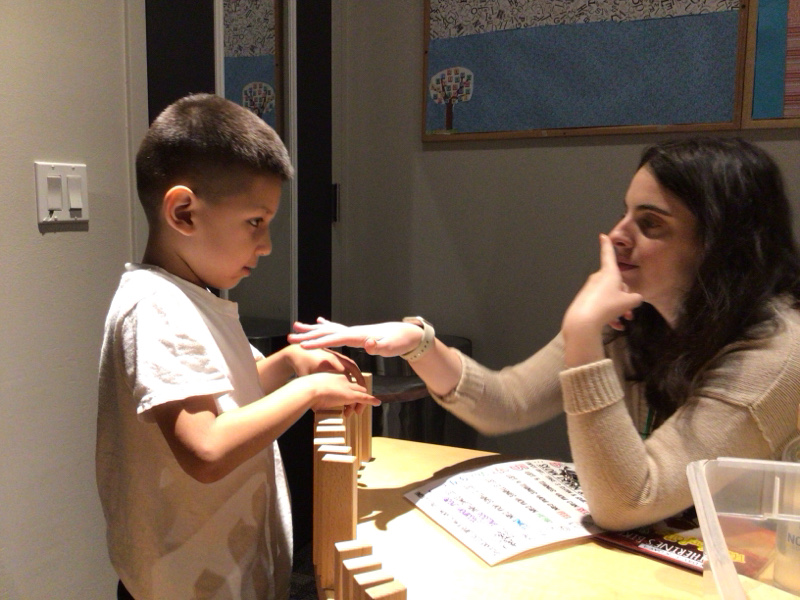
Social workers can help provide your child with tools to help manage their feelings of anxiousness in a school setting. They can role-play introducing themselves or asking to join a game. They break down the complex dance of friendship into steps: making eye contact, smiling, taking turns.
Modeling Behavior
Social workers can help model appropriate behavior for social situations. They act as a coach. “Hey, did you see how Sarah shared her blocks? That made her friend smile. Let’s try that.” They make the abstract concept of “being nice” concrete and actionable.
 Managing Impulsive Behaviors
Does your child struggle with impulsive behaviors? The blurting out, the grabbing, the running off. It can be exhausting for them and for you.
Social workers can help your child manage emotions and learn coping tools. They teach the difference between a “big deal” and a “little deal.” Spilled milk? Little deal. Fire alarm? Big deal. Matching the reaction to the problem is a learned skill.
Expected vs. Unexpected Behaviors
Self-management skills can be developed by learning expected vs. unexpected behaviors in the classroom.
- Expected: Raising your hand, sitting in your chair, using kind words. These behaviors make others feel comfortable.
- Unexpected: Yelling, running in the library, grabbing toys. These behaviors make others feel uncomfortable or confused.
By framing it this way, it removes the shame of “bad” behavior and turns it into a social puzzle to solve. “Was that behavior expected for library time?” helps a child reflect without feeling attacked.
Identifying and Processing Feelings
Does your child need help with identifying emotions? “Fine,” “mad,” and “happy” are often the only words kids have. But there is a whole world between “mad” and “furious,” or “sad” and “disappointed.”
Social workers can help your child with emotion identification and regulation skills. They might use an “emotion wheel” or charts with faces to help your child point to exactly how they feel.
Processing the Messy Stuff
Social workers can help your child process their feelings. Once the feeling has a name, it’s less scary. “Oh, I’m feeling jealous because Timmy got the line leader spot.” Okay, now we can do something with that.
Emotion identification is an important skill that helps children learn to identify emotions in themselves and others. This builds empathy. If they know how “embarrassed” feels, they are less likely to embarrass a friend intentionally.
High School Overwhelm
Is your child feeling overwhelmed in high school? High school is a different beast. The stakes are higher, the social circles are tighter, and the future is looming.
Test Anxiety (Teen Edition)
Does your child seem overwhelmed with taking a test? The SATs, ACTs, and finals can be crushing.
Did you know that between 25%-45% of students experience test anxiety? In high school, this can look like perfectionism or complete procrastination (avoiding the studying because the anxiety is too high).
Symptoms to look for: headaches, shortness of breath, difficulty concentrating, stomach-ache.
Social workers can help your child with testing anxiety by giving them coping tools to help with increasing their self-esteem and reframing negative thoughts. They help teens realize their worth isn’t a number on a page.
 Healthy Relationships and Decision Making
Does your child struggle with healthy relationships? Do they have a good group of friends? Are they experiencing bullying? Are they experiencing peer pressure?
Social workers can help your teen understand healthy relationships and positive decision-making. They provide a space to talk about dating, friendships that feel “off,” or pressure to do things they don’t want to do.
Social workers can be there to help your teen process overwhelming emotions they may be having. Teens often don’t want to talk to parents about this stuff. A social worker is a neutral, safe adult who can guide them without the “parent lecture” vibe.
Support for Mental Health Diagnoses
Does your adolescent have a diagnosis of anxiety and/or depression? These aren’t just “phases.” They are real medical conditions that affect learning.
Social workers can help process their emotions at school. If a panic attack hits during third period, the social worker is there.
If not able to have therapy after school, support can be provided during the school day. This is crucial for busy families. You don’t have to drive across town at 5 PM; the support is built into their daily environment.
Evidence-Based Practice
Social workers can use evidence-based practice interventions to help with a mental health diagnosis. This means they use methods that are proven to work, like Cognitive Behavioral Therapy (CBT) techniques tailored for teens.
Social workers can help your adolescent come up with coping tools to manage overwhelming emotions. This might be a playlist that calms them down, a journaling habit, or specific grounding techniques to stop a spiral.
Navigating Family Changes: Separation and Divorce
Is your child experiencing a loss or parent separation or divorce? When the family foundation shakes, school often suffers.
Social workers can provide support to help your child process a parent separation or divorce. They are the steady hand when home feels chaotic.
We understand that your child can experience overwhelming feelings and can help your child learn tools to help cope. They validate that it is okay to be sad, angry, or confused.
A Safe Space
Social workers can provide a safe space for the child to process their feelings and ask questions they may have. ” is it my fault?” “Will I still see Dad?” They can answer these or help the child ask the parents.
You are not alone. Many kids are dealing with their parents getting a divorce or separation. Connecting them with a social worker can sometimes help them connect with other kids in similar boats, normalizing the experience.
Coping with Loss
Loss of a loved one is devastating at any age, but for a child, it can be confusing and terrifying.
Social workers can provide support to help your child process a loss of a loved one. They understand the stages of grief don’t happen in a neat line.
We understand that your child can experience overwhelming feelings and can help your child learn tools to help cope. Whether it is a grandparent, a parent, or even a beloved pet, the grief is real.
Social workers can provide a safe space for the child to process their feelings and ask questions they may have. They can help process grief by working with your child on understanding their thoughts, emotions, and behaviors. They might make a memory box or write a letter to the loved one, finding closure in ways that make sense to a child.
We Are Here to Help
You don’t have to navigate this maze alone. Eyas Landing social workers can help! We are passionate about flexibility and meeting families where they are—whether that is in our clinic, in your home, or right there in the classroom.
Check with your school to see if they allow private social workers to support students during school hours. Many do, and it can be a game-changer for your child’s day.
If you are seeing any of these struggles—from test anxiety to trouble making friends—reach out. Let’s build a team around your child so they can stop just surviving school and start thriving in it.
Contact Eyas Landing today to learn more about our social work services and how we can support your family.
What Is Eyas Landing?
“Eyas” is defined as a young hawk in the developmental stage of learning to fly. At Eyas Landing, it’s not only
about the flight, but also the landing. “As our clients succeed in therapy, they succeed in every aspect of their daily life.”- Dr. Laura Mraz, OTD, OTR/L Founder of Eyas Landing since 2007
Three Birds. One Mission.
Eyas Landing is just one part of your child’s journey! Our sister companies, Blue Bird Day and Merlin Day Academy, work together to support your child as they grow. Blue Bird Day, our therapeutic preschool and kindergarten program, is an intensive rotational therapeutic program designed to provide children ages 2-7 with the tools they need to succeed in a classroom environment. Merlin Day Academy— accredited by the Illinois State Board of Education—provides special education and multi-disciplinary therapy for children ages 6-14 with neuro-diverse learning needs.

Eyas Landing is a therapy clinic with a mission to provide evidence-based and family-centered therapy services for children, adolescents, and their families. The primary goal is to deliver relationship-based interventions within the most natural environments and to empower families to reach their full potential. To achieve this goal, our highly educated, compassionate staff dedicates time and expertise to create experiences that maximize therapeutic outcomes. The strength, determination, and perseverance of our clients are evident as they succeed in therapy, and ultimately in their daily lives.
Eyas Landing offers a wide range of comprehensive services including Speech Therapy, Occupational Therapy, Physical Therapy, ABA Therapy, Social Work, Family Therapy, and Neuropsych testing. Services are provided throughout the Chicagoland area via Telehealth, In-Home, and in our state of the art clinic.
Want to learn more or you have a specific question? Feel free to connect with us here!