Is Your Child’s Speech and Language Delayed?
It starts with a feeling. Maybe you’re at the park, watching other children the same age as yours. You hear them chattering away, pointing at birds, and calling for their parents. Then, you look at your own child, who is playing quietly, perhaps pointing but not saying much. Or maybe you’re facing another meltdown because your toddler knows what they want but just can’t find the words to tell you.
If you are asking yourself, “Is my child’s speech delayed?” know that you are not alone. It is one of the most common concerns parents face. It is also a concern that comes with a heavy dose of anxiety. You might worry about their future, their ability to make friends, or their success in school.
At Eyas Landing, we understand how overwhelming this can feel. Your concerns are completely valid. But here is the good news: You are your child’s best advocate, and you are asking the right questions. Communication challenges are common, and with the right support, children can make incredible progress.
This guide is designed to help you navigate these uncertain waters. We will walk through what typical development looks like, signs that might indicate a need for support, and how early intervention—getting help sooner rather than later—can change your child’s developmental trajectory.
The Power of Early Intervention
You might have heard friends or family say, “Don’t worry, they’ll grow out of it,” or “Boys just talk later than girls.” While these sentiments are meant to be comforting, they can sometimes delay necessary support.
Waiting and seeing is a passive approach. Early intervention is active. It is about identifying challenges as soon as possible and providing the tools a child needs to overcome them. The brain of a child under the age of three is developing at a lightning-fast pace. It is more “plastic,” or changeable, during these early years than at any other time in life. This means that therapy provided now is often more effective and takes less time than therapy provided later in school.
When we talk about early intervention at Eyas Landing, we aren’t just talking about teaching a child to say “ball” or “cookie.” We are talking about reducing frustration. When a child cannot communicate, behaviors often escalate. A toddler who hits or screams is often a toddler who is desperate to be understood. By giving them a way to communicate—whether through words, signs, or pictures—we often see a dramatic drop in challenging behaviors and a huge boost in confidence.
Understanding the Basics: Speech vs. Language
Before we dive into milestones, it is helpful to understand that “speech” and “language” are actually two different things.
- Speech is how we say sounds and words. It involves articulation (making sounds clearly), voice (using the vocal cords), and fluency (the rhythm of speech). A child with a speech delay might say “baba” for “bottle” long after their peers are saying the whole word.
- Language is how we use words to share ideas and how we understand what others say. It includes vocabulary, grammar, and social communication. A child with a language delay might be able to pronounce words perfectly but struggles to put two words together or doesn’t understand simple instructions like “get your shoes.”
Your child may have challenges with one, the other, or both. A Speech-Language Pathologist (SLP)—an expert trained specifically to help kids like yours communicate—looks at both areas to create a full picture of your child’s abilities.
Speech and Language Milestones: Ages 1-3
Every child develops on their own unique timeline. Just because your neighbor’s two-year-old is speaking in full paragraphs doesn’t mean your child is behind if they aren’t doing the same. However, there are general milestones—skills that most children master by a certain age—that serve as helpful guideposts.
Here is a look at what we typically expect to see during the toddler years.
12 Months (1 Year) Speech Milestones:
At the one-year mark, communication is blossoming. Your baby is likely becoming a social being.
Receptive Language (Understanding): They recognize their name when you call it. They understand simple instructions like “no” or “give it to me,” often accompanied by gestures. They enjoy games like Peek-a-Boo.
Expressive Language (Talking): They are likely waving “bye-bye” and shaking their head “no.” You should be hearing a lot of babbling with changes in tone (it sounds like a conversation, just without real words). Most children have one or two spoken words, like “mama,” “dada,” or “uh-oh,” though they may not be perfectly clear yet.
18 Months (1.5 Years) Speech Milestones:
This is often when the “vocabulary burst” begins.
Receptive Language: They can point to a few body parts when asked (e.g., “Where is your nose?”). They can follow simple, one-step commands without you needing to use gestures (e.g., “Get the ball”).
Expressive Language: Your child likely uses at least 10 to 20 words consistently. They are starting to imitate words they hear you say. They are using words to ask for things they want, rather than just crying or pointing.



24 Months (2 Years) Speech Milestones:
Two is a major turning point for language structure.
Receptive Language: They understand simple questions like “Where is the cat?” or “What is that?” They can follow two-step directions, such as “Pick up the toy and put it in the box.”
Expressive Language: Their vocabulary has grown to 50 words or more. The biggest milestone here is combining two words together, like “Mommy go,” “more juice,” or “big truck.” Family members can understand their speech about 50% of the time.
36 Months (3 Years) Speech Milestones:
By age three, your child’s world is expanding, and their language should reflect that.
Receptive Language: They understand concepts like “in,” “on,” and “under.” They can answer “who,” “what,” and “where” questions.
Expressive Language: They are using sentences of 3-4 words or more. They can tell you a simple story or talk about something that happened yesterday. Strangers (people who don’t live with you) should be able to understand about 75% of what they say.
Speech Red Flags: When to Look Closer
While milestones are flexible, there are certain “red flags” that suggest a child might need extra support. If you notice these signs, it does not mean something is “wrong” with your child—it simply means they might need a specialized strategy to help them catch up.

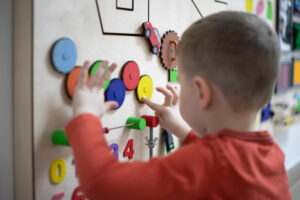
Speech Red Flags at Any Age:
- Regression: If your child stops using words they used to say or stops waving/pointing, this is a sign to seek an evaluation immediately.
- Lack of Response: If your child does not respond to sound or their name, it is important to rule out hearing loss first.
Speech Red Flags at 12 Months Old:
- Does not use gestures like pointing or waving.
- Does not babble or use a variety of sounds.
Speech Red Flags at 18 Months Old:
- Prefers gestures over vocalizations to communicate.
- Has trouble imitating sounds.
- Has a vocabulary of fewer than 10 words.
Speech Red Flags at 2 Years Old:
- Only imitates speech or actions and doesn’t produce words or phrases spontaneously.
- Says only certain sounds or words repeatedly and cannot use oral language to communicate more than their immediate needs.
- Cannot follow simple directions.
- Has an unusual tone of voice (such as raspy or nasal sounding).
Speech Red Flags at 3 Years Old:
- Family members and regular caregivers have difficulty understanding their speech.
- Cannot combine words into simple sentences.
- Shows frustration when trying to communicate, leading to tantrums or withdrawal.
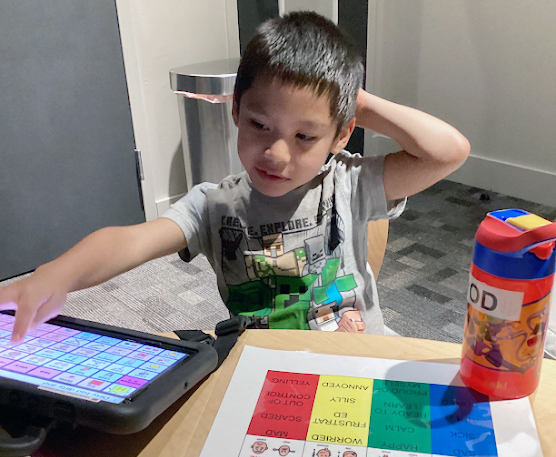
The Role of the Speech-Language Pathologist (SLP)
If you are seeing red flags, the next step is usually an evaluation by a Speech-Language Pathologist (SLP). The title sounds very medical, but at Eyas Landing, our SLPs are warm, playful experts who specialize in connecting with children.
What Happens During an Evaluation?
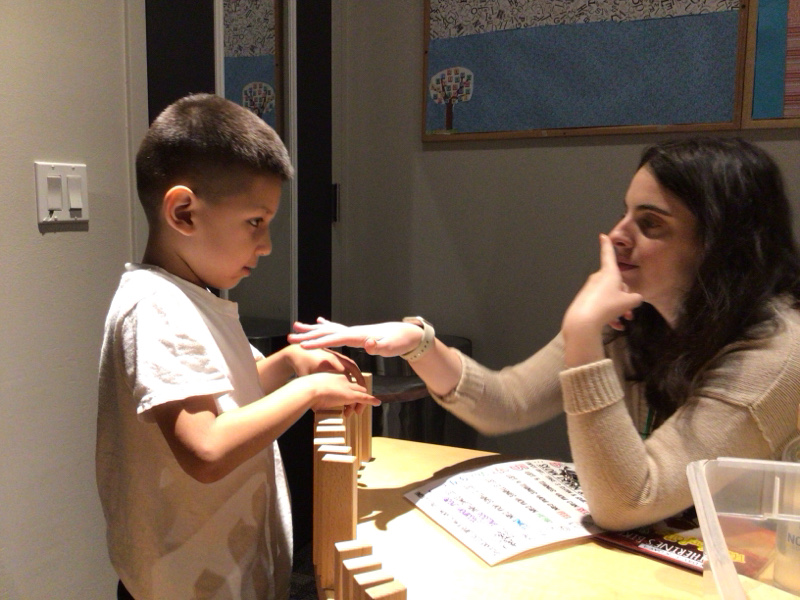
Parents often worry that an evaluation will be scary or stressful for their child. In reality, a good pediatric evaluation looks a lot like playtime!
We meet families where they are—emotionally and physically. Whether the evaluation happens at our clinic in the West Loop, via TeleHealth, or in your home, the goal is to see how your child communicates in a natural environment.
The therapist will play with your child using toys, books, and pictures. They are observing:
- How your child asks for things (Do they point? Grunt? Use words?).
- How many words they understand.
- The clarity of their speech sounds.
- Their social skills (Do they make eye contact? Do they take turns?).
- Oral motor skills (How their mouth, jaw, and tongue work for eating and speaking).
Following this, we collaborate with you. We ask about your goals. Do you want your child to be able to say “I love you”? Do you want them to be able to ask for a snack without screaming? Your family’s goals become our goals.
Multi-Disciplinary Collaboration
One of the unique strengths of Eyas Landing is that we look at the whole child. Sometimes, a speech delay isn’t just about speech.
- If a child has low muscle tone, they might struggle to produce sounds. Our Physical Therapists (PT) can help strengthen their core and posture to support breath for speech.
- If a child has sensory processing challenges and gets overwhelmed easily, they might shut down and stop talking. Our Occupational Therapists (OT) can help regulate their sensory system so they are calm enough to learn.
- If behaviors are interfering with learning, our ABA (Applied Behavior Analysis) team can teach skills by breaking them into small, achievable steps.
This multi-disciplinary collaboration ensures we aren’t just treating a symptom; we are supporting the whole child and the whole family.
Flexible Therapy Settings: Meeting You Where You Are
We know that life with a young child is busy. Adding therapy appointments can feel like a logistical puzzle. That is why flexibility is the foundation of our approach. We believe therapy should fit your life, not the other way around.
Clinic-Based Therapy:
Our West Loop facility is designed specifically for children. It includes sensory gyms and specialized therapy rooms that encourage exploration. For many children, coming to a new, exciting place helps them engage in ways they might not at home.
Home-Based Therapy:
Sometimes, children learn best in their own environment. We can come to your home, using your toys and your daily routines to teach communication. This is fantastic for “carryover”—helping your child use their new words in real life, not just in a therapy room.
TeleHealth:
For adolescents or families with tight schedules, TeleHealth is a powerful tool. We coach you on how to be the therapist during the session, guiding you through interactions with your child. This empowers you with skills you can use every single day.
School and Community Settings:
We can also provide services at your child’s school or daycare, ensuring they are supported in their educational environment.
Actionable Steps: What You Can Do Now
If you suspect a delay, the waiting period between realizing there is an issue and getting an appointment can be stressful. But there is plenty you can do right now to support your child’s development.
1. Trust Your Gut and Take Notes
You know your child better than anyone. If something feels off, trust that instinct. Start keeping a simple log. Write down the words your child says, the gestures they use, and situations where they seem frustrated. This information is gold for your pediatrician and therapists.
2. Narrate Your Day
Bathing, dressing, and feeding are prime language opportunities. Narrate what you are doing using simple language. “Wash tummy. Wash toes. Water is warm!” You aren’t expecting them to repeat you; you are just pouring language into their “bucket” so that eventually, it can overflow into speech.
3. Read, Read, Read
Reading is one of the best ways to build vocabulary. You don’t even have to read the words on the page. Just look at the pictures and talk about what you see. “Look at the dog. The dog is running!”
4. Create “Communication Temptations”
Instead of handing your child their juice immediately, hold it just out of reach for a second. Wait to see if they look at you, point, or make a sound. Give them the juice immediately when they make an attempt. This teaches them that communication has power.
5. Schedule an Evaluation
Don’t wait for the “right time.” The right time is now. Contact your pediatrician for a referral or reach out to a private therapy provider like Eyas Landing directly. In Illinois, you can also explore Early Intervention services if your child is under three.
A Partner in Your Child’s Journey
Recognizing that your child might have a speech or language delay can be emotional. It is normal to feel worried, but try to let hope be the louder voice in your head. Speech delays are highly treatable.
By seeking information and looking for support, you are already taking the most important step. You are opening doors for your child. Whether they find their voice through spoken words, sign language, or a communication device, the goal is connection.
At Eyas Landing, our mission is to give every child the opportunity to thrive. We don’t just work on articulation or grammar; we work on confidence. We work on the joy of connecting with others. Whether your child finds their confidence at home, builds friendships at school, or reaches a milestone in our clinic, we are there—every step of the way.
Together, we can partner with your family to turn frustration into communication and potential into progress.
“Eyas” is defined as a young hawk in the developmental stage of learning to fly. At Eyas Landing, it’s not only
about the flight, but also the landing. “As our clients succeed in therapy, they succeed in every aspect of their daily life.”- Dr. Laura Mraz, OTD, OTR/L Founder of Eyas Landing since 2007
Three Birds. One Mission.
Eyas Landing is just one part of your child’s journey! Our sister companies, Blue Bird Day and Merlin Day Academy, work together to support your child as they grow. Blue Bird Day, our therapeutic preschool and kindergarten program, is an intensive rotational therapeutic program designed to provide children ages 2-7 with the tools they need to succeed in a classroom environment. Merlin Day Academy— accredited by the Illinois State Board of Education—provides special education and multi-disciplinary therapy for children ages 6-14 with neuro-diverse learning needs.

Eyas Landing is a therapy clinic with a mission to provide evidence-based and family-centered therapy services for children, adolescents, and their families. The primary goal is to deliver relationship-based interventions within the most natural environments and to empower families to reach their full potential. To achieve this goal, our highly educated, compassionate staff dedicates time and expertise to create experiences that maximize therapeutic outcomes. The strength, determination, and perseverance of our clients are evident as they succeed in therapy, and ultimately in their daily lives.
Eyas Landing offers a wide range of comprehensive services including Speech Therapy, Occupational Therapy, Physical Therapy, ABA Therapy, Social Work, Family Therapy, and Neuropsych testing. Services are provided throughout the Chicagoland area via Telehealth, In-Home, and in our state of the art clinic.
Want to learn more or you have a specific question? Feel free to connect with us here!