10 Ways to Improve Your Child’s Balance
Many children present with deficits in balance and coordination that can impact their ability to move and play confidently. At Eyas Landing’s clinic, most standardized assessments examine both a child’s static balance and dynamic balance skills.
Static balance refers to the body’s ability to maintain a stationary position by activating postural control muscles and holding an upright posture. This requires keeping the body’s center of mass over a base of support, which may be wide (such as standing with feet apart) or narrow (such as standing on one foot). Examples of static balance range from a baby sitting upright without tipping over to an older child holding a yoga “tree” pose on one foot.
Dynamic balance involves maintaining upright posture and control while the body is in motion. Examples include walking across a balance beam, riding a bike, or hopping on one foot during a game of hopscotch. These skills often require transferring weight from one foot to the other, such as during running or skipping. Balance is influenced by multiple body systems, including vision, proprioception (the body’s awareness of its position in space), and the vestibular system (inner ear structures that detect head position and movement). These systems must work together to produce effective balance. When one system is relied on too heavily or another is underutilized, balance may be affected, which can influence a child’s ability to play, participate in sports, and engage in age-appropriate activities.
If a child is struggling with balance skills compared to peers, or if there are questions about age-appropriate expectations, Eyas Landing’s Physical Therapy team can help. While the clinics and gyms offer a wide range of specialized Physical Therapy equipment, many effective balance activities can also be completed at home between therapy sessions.
Below are 10 easy ways to incorporate balance training into busy schedules and make it a regular part of a child’s routine.
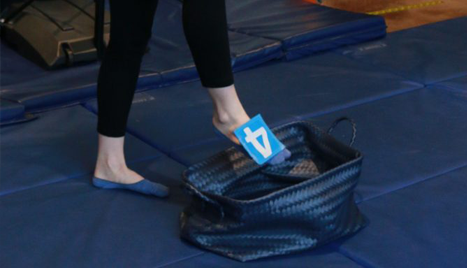
1. Clean Up time
What better way to incorporate some balance skills than during clean-up from a previous game? Have your child place items such as bean bags, cards from a game, etc. onto the top of their foot. Then, tell them to use their foot to drop the item back into the box or container it belongs in. They can use brief periods of single-leg stance to clean up the items. You may have to assist with holding the item on the top of their foot. If they are a bit older, they can lift their toes upward and independently maintain the toy on their foot while slowly dropping it into the box. This strengthens the muscles on top of their ankles as well, which is great for gait training!
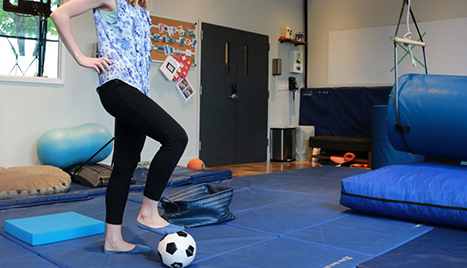
2. One Foot Elevated on Soccer Ball
This is just a step up from standing with one foot elevated on a bench. The ball is much more dynamic, as it can roll under the child’s foot, further challenging their balance. You can also have the child stand and tap their feet on the ball, alternating left and right and trying to keep the ball in place.
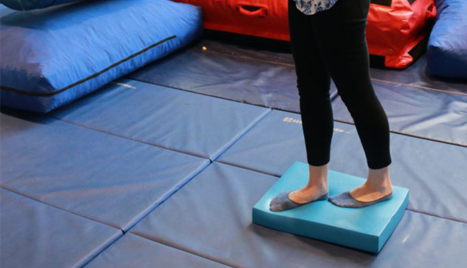
3. Tandem Stance/ Semi-Tandem Stance
Have your child stand with one foot in front of the other, heel to toe. This will narrow their base of support and challenge their static balance. If this is too challenging, have them place one foot aligned with the center of their other foot, which we call “semi-tandem” stance. If this is too easy, have them try closing their eyes! You can work on dual task activities as well, such as singing a nursery rhyme or catching a ball.
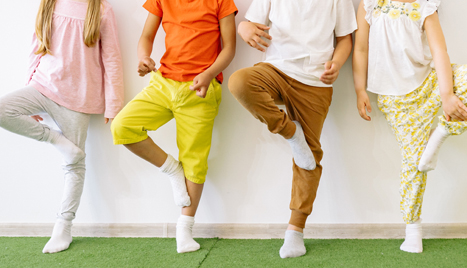
4. Taking Shoes and Socks On and Off
When little ones are first learning to balance on one foot, it can be helpful to practice during regular routines, such as taking shoes and socks on and off. Try to prolong the time they spend standing on one foot while you hold up their sock or shoe. Do they need to hold onto you or the wall, or can they attempt to lift their foot without additional support for 1-3 seconds? Try to progress the amount of time they can balance this way.
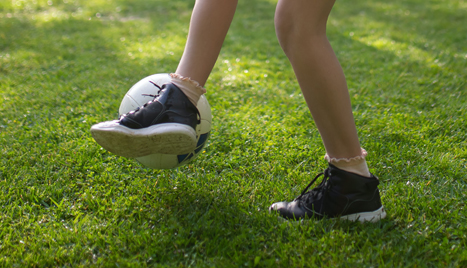
5. Kicking a Ball
Something as simple as kicking a playground ball can also strengthen a child’s balance skills. Have them work on using “wind-up,” in which they bring their leg backwards before drawing it forward to contact the ball. Again, you can try having them lift their foot in preparation to kick, count to 3, then send the ball soaring across the room!
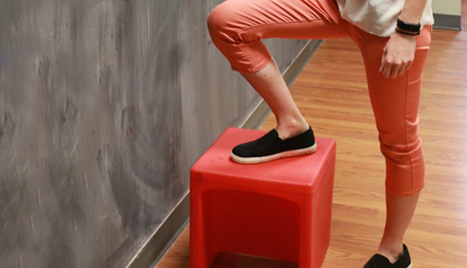
6. Just Beginning to Balance – One foot elevated to play
I usually expect a child to be able to stand on one foot for about 3 seconds by the age of 3 years. If you suspect your child is not quite there yet, or if they are under the age of 3 but you want to start working on their balance now, this is a nice way to begin working on weight shifting from one side to the other. Have your child stand with one foot elevated on a stepstool or small bench, so that one foot is resting on the floor and the other foot is resting on the bench. This will shift their weight to the foot on the floor and works as a precursor to balancing on one foot. You can have them maintain this position while coloring on a chalk board or easel. Try playing a simple game of catch or beanbag toss in this position. Don’t forget to switch feet so that your child can begin to build these skills equally on both sides.
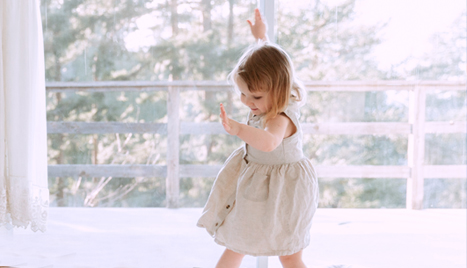
7. Freeze Dance
If you are playing with a group of kiddos, it can be motivating to play a game of freeze dance. Start the music, have them mimic your body movements, and then have them “freeze” in place when you suddenly stop the music. Make sure you include moves that will cause them to freeze in place on one foot, like marching with high knees, or hopping from one foot to the other.
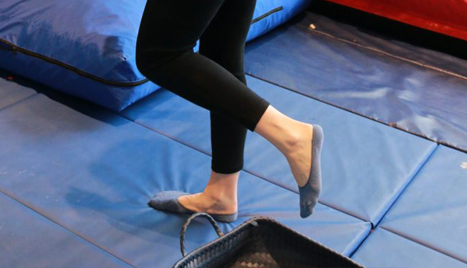
8. Heel Taps
Sometimes I place colored spot markers in a semi-circle around the child and call out various color patterns, having them lift one foot and tap their heel to each color in the correct order. Have them try to avoid placing their foot down for support between colors! If you don’t have any colored spots to use, try marking some spots outside with colored sidewalk chalk or simply cut and color some pieces of paper instead!
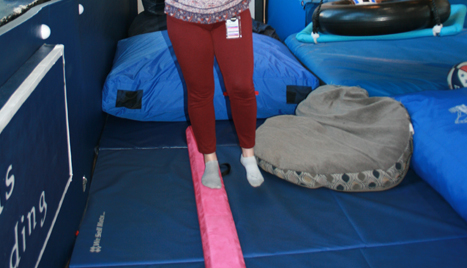
9. Walking the Balance Beam
While therapists frequently use balance beams in the clinic to encourage dynamic balance skills, you don’t have to go out and purchase one for use in the home. Taking a walk to the park? Use the curb as a balance beam and encourage stepping one foot in front of the other without tipping off! You can also use a tape line (painter’s tape peels off easily) or a line of chalk on the driveway to still encourage walking with a narrow base in order to challenge their dynamic balance skills. How many steps can they take before stepping off the line?
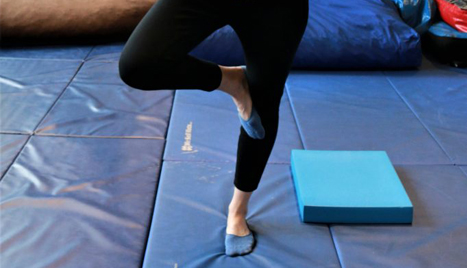
10. Tree Pose
This is one of my favorite yoga poses to work on with kids. Have your child stand with one knee bent and foot resting on opposite leg for balance. Encourage them to stare ahead at a stationary object in order to improve their control.
If you need assistance with modifying these exercises and/or increasing the level of difficulty for your child, please reach out to their therapy team! Eyas Landing’s Physical Therapists will be able to provide tailored recommendations based on your child’s treatment goals.
“Eyas” is defined as a young hawk in the developmental stage of learning to fly. At Eyas Landing, it’s not only
about the flight, but also the landing. “As our clients succeed in therapy, they succeed in every aspect of their daily life.”- Dr. Laura Mraz, OTD, OTR/L Founder of Eyas Landing since 2007
Three Birds. One Mission.
Eyas Landing is just one part of your child’s journey! Our sister companies, Blue Bird Day and Merlin Day Academy, work together to support your child as they grow. Blue Bird Day, our therapeutic preschool and kindergarten program, is an intensive rotational therapeutic program designed to provide children ages 2-7 with the tools they need to succeed in a classroom environment. Merlin Day Academy— accredited by the Illinois State Board of Education—provides special education and multi-disciplinary therapy for children ages 6-14 with neuro-diverse learning needs.

Eyas Landing is a therapy clinic with a mission to provide evidence-based and family-centered therapy services for children, adolescents, and their families. The primary goal is to deliver relationship-based interventions within the most natural environments and to empower families to reach their full potential. To achieve this goal, our highly educated, compassionate staff dedicates time and expertise to create experiences that maximize therapeutic outcomes. The strength, determination, and perseverance of our clients are evident as they succeed in therapy, and ultimately in their daily lives.
Eyas Landing offers a wide range of comprehensive services including Speech Therapy, Occupational Therapy, Physical Therapy, ABA Therapy, Social Work, Family Therapy, and Neuropsych testing. Services are provided throughout the Chicagoland area via Telehealth, In-Home, and in our state of the art clinic.
Want to learn more or you have a specific question? Feel free to connect with us here!